Hotel Phone System Cost: 7 Factors That Determine Your Budget
“How much does a hotel phone system cost?” sounds like a simple question. Unfortunately, there is no universal answer. A hotel communication project may involve much more than the phone platform itself. Room count, handsets, cloud licensing, existing infrastructure, PMS integration and hospitality functionality can all affect the final cost.
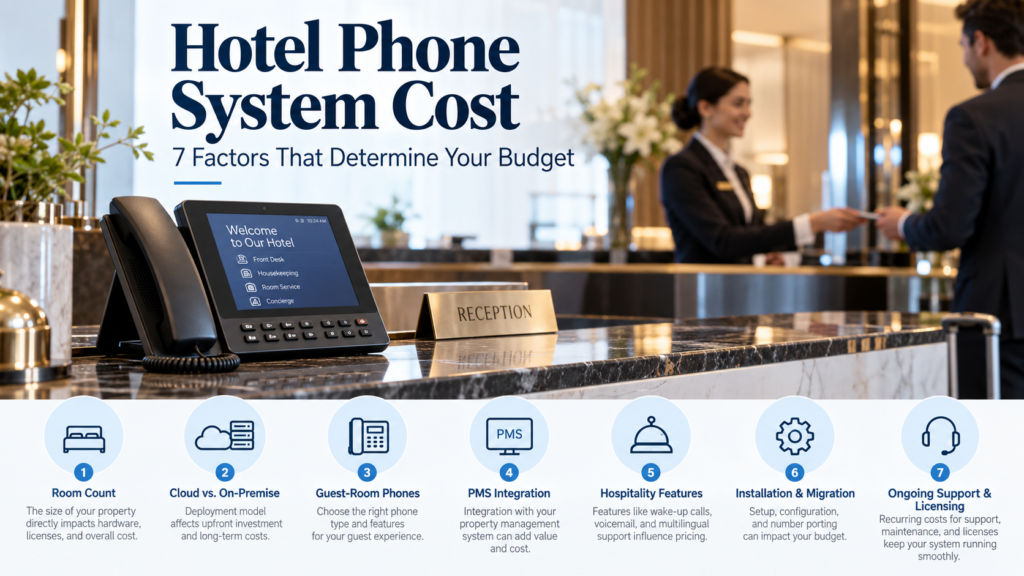
Here are seven areas hotels should budget for.
1. Number of Rooms and Extensions
A 50-room property and a 500-room resort require very different communication environments. Pricing may depend on:
- Guest rooms
- Front desk phones
- Administrative users
- Back-office staff
- Departments
- Multiple buildings or properties
This is why room and extension count is usually one of the first questions vendors ask.
2. Cloud, On-Premise or Hybrid
The underlying communication platform can also change the cost structure. Cloud systems often rely more heavily on recurring licenses, while on-premise environments may require more equipment at the property. Some hotels use a hybrid approach to retain existing guest-room infrastructure while modernizing other parts of the system.
3. Existing Guest-Room Phones
Replacing hundreds of room phones can become a major project expense. Before assuming every handset must be replaced, determine whether the existing phones and wiring can remain.
In some environments, analog room phones can continue operating through compatible gateways.
4. PMS Integration
This is one of the most frequently overlooked parts of a hotel phone-system quote. Hotels may need the communication environment to react automatically to:
- Check-in
- Checkout
- Room moves
- Guest-name changes
- Wake-up requests
- Room status
- Calling permissions
That integration may require hospitality middleware such as DuVoice.
5. Hospitality Features
Hotels should determine which services they actually require.
Examples include:
- Guest voicemail
- Automated wake-up calls
- Room-status reporting
- Emergency alerts
- Guest messaging
- Call accounting
- Minibar posting
- Web-based management
Not every hotel needs every feature.
6. Installation and Migration
Implementation costs may include:
- Configuration
- Integration setup
- Testing
- Number porting
- Network changes
- Staff training
- Cutover support
Hotels should also plan migrations carefully so guest services remain available during the transition.
Your existing Hotel Phone System Upgrade Checklist is a perfect internal link here.
7. Ongoing Licensing and Support
The initial installation price is only part of the total cost.
Hotels should ask vendors to clearly identify:
- Monthly licensing
- Annual support
- Guest-room extension fees
- Integration licensing
- Maintenance
- Future expansion costs
A lower initial quote is not necessarily less expensive over the full life of the system.
Don’t Forget the Hospitality Integration Layer
DuVoice is not a phone provider. Instead, DuVoice connects supported hotel phone platforms with Property Management Systems and hospitality communication workflows.
That distinction matters when budgeting. If a hotel selects RingCentral, Webex Calling, Zoom Phone, Avaya, Mitel, Cisco or another supported environment, the property may still require an integration layer for PMS connectivity, wake-up calls, voicemail, room status and other hotel-specific services.
Get the Complete Picture Before Comparing Quotes
The true hotel phone-system cost is not simply the cost of the phones. Hotels should evaluate: Phone platform + hardware + PMS integration + hospitality features + installation + ongoing support before comparing proposals.
Planning these requirements before selecting a provider can prevent expensive surprises later.
If you’re planning a hotel communications upgrade, contact DuVoice to discuss the PMS and hospitality integration portion of your project.
Contact us
- Email: sales@duvoice.com
- Phone: 425-250-2393 || 425-889-9790